
Section 1: Introduction
Tribunals Ontario enters the 2026–2029 planning cycle with a clear commitment to delivering effective administrative justice and to being innovative, user-friendly and accessible. Building on recent progress, including backlog reduction, improved digital service delivery, expanded adjudicator capacity, and organizational improvements driven by Lean methodologies, we are now well positioned to build on our foundations to deliver even more timely, accessible, and effective services for the people of Ontario.
Over the next three years, Tribunals Ontario will focus on advancing three strategic priorities: User Experience, Digital Modernization, and People First. These priorities reflect our future‑oriented vision and guide how we will adapt to rising caseloads, evolving user needs, and technological change. Our work will include enhancing the virtual hearing experience, expanding plain‑language communication, modernizing case management systems, and building a data‑driven culture that strengthens decision‑making and improves performance. We will also continue to actively recruit and train adjudicators and staff to ensure we have the talent and capacity required for long‑term sustainability.
As an organization committed to accountability, transparency, and operational excellence, Tribunals Ontario remains focused on modernizing operations, measuring results and enhancing access to justice. We will continue implementing streamlined processes, strengthening our digital platforms, and investing in tools that support both efficiency and accessibility.
As we move forward, Tribunals Ontario remains committed to transparency and measurable results. We will monitor progress through clear Key Performance Indicators, publish service timelines to strengthen predictability for users, and continually engage with stakeholders to ensure our services remain responsive, fair, and user‑friendly.
Together, these efforts position Tribunals Ontario to deliver on our vision of providing access to fair and timely justice for all Ontarians.
Section 2: Mandate
Mandate
Tribunals Ontario is a group of 12 adjudicative tribunals with a mandate to resolve and decide matters arising from over 50 statutes relating to safety, licensing, property assessment, residential tenancies and social justice.
Mission
Tribunals Ontario will be best in class in the delivery of effective administrative justice through tribunals that are independent, innovative, user-friendly and accessible.
Vision
Providing access to fair and timely justice for all Ontarians.
Core Values
Accountability - We deliver high quality services consistently and with regard to value for money, resulting in a fair, transparent and accessible experience for parties, stakeholders, and our colleagues.
Excellence - We strive for service excellence and commit to continuous learning and improvement.
Inclusion - We deliver services that are designed to promote informed and meaningful participation and which support diversity.
Integrity - We act with honesty and with professionalism, exhibiting the highest standards of public service.
Respect - Our actions demonstrate continued respect towards the public, our colleagues, and the law.
Section 3: Overview of Programs and Activities
Tribunals Ontario is responsible for 12 boards, tribunals, and commissions (constituent tribunals) that fall under the Ministry of the Attorney General (MAG).
The constituent tribunals use a variety of dispute resolution methods and conduct different types of events, including hearings, case management conferences, pre-hearings, motion hearings and mediation sessions to resolve disputes between parties. The tribunals process files from intake to closure, which may include issuance of decisions, orders and recommendations arising from pre-hearings and mediations, settlement conferences and if required, a formal hearing.
Effective September 1, 2025, the Ontario Civilian Police Commission was dissolved and is no longer operational. On April 1, 2024, the Community Safety and Policing Act, 2019 (CSPA) came into force and the Police Services Act (PSA) was repealed.
The following entities have responsibility for policing matters under the CSPA:
- Inspectorate of Policing
- Law Enforcement Complaints Agency
- Ontario Police Arbitration and Adjudication Commission
The specific mandates for the 12 constituent tribunals are set out below.
Animal Care Review Board (ACRB) resolves disputes and conducts hearings regarding animal welfare, including hearing appeals of orders and decisions of the Chief Animal Welfare Inspector and other animal welfare inspectors. When reviewing appeals and applications, the welfare of any animal involved is the ACRB’s main priority.
Assessment Review Board (ARB) hears property assessment appeals to ensure that properties are assessed and classified in accordance with the provisions of the Assessment Act. The ARB also operates under a variety of other statutes and hears appeals on property tax matters.
Child and Family Services Review Board (CFSRB) conducts reviews, hearings and appeals for matters affecting children, youth, and families in Ontario, including Children’s Aid Society services complaints, emergency secure treatment admissions, adoption refusals, removal of a child from a foster home, and appeals of school board expulsions.
Custody Review Board (CRB) reviews placement decisions regarding young persons being held in detention or custody and makes recommendations to the Provincial Director regarding the placement of youth.
Fire Safety Commission (FSC) resolves disputes and conducts hearings regarding fire safety matters, including orders made by inspectors or the Fire Marshal for repairs, alterations or installations to a building, structure, or premises.
Human Rights Tribunal of Ontario (HRTO) resolves claims of discrimination and harassment brought under the Human Rights Code.
Landlord and Tenant Board (LTB) resolves disputes between residential landlords and tenants and resolves eviction applications filed by non-profit housing co-operatives. The LTB also provides information about its practices and procedures and the rights and responsibilities of landlords and tenants under the Residential Tenancies Act, 2006.
Licence Appeal Tribunal (LAT) adjudicates applications and resolves disputes concerning compensation claims and licensing activities regulated by the provincial government, including the activities of delegated administrative authorities. The LAT is comprised of two divisions: General Service (LAT-GS) and Automobile Accident Benefits Service (LAT-AABS).
Ontario Parole Board (OPB) makes parole decisions for applicants serving a sentence of less than two years in a provincial correctional institution. The OPB also decides applications for temporary absences from a correctional institution for greater than 72 hours.
Ontario Special Education Tribunals - English and French (OSETs) hear appeals by parents and guardians who are not satisfied with the school board’s identification or placement of a child with exceptional learning needs.
Social Benefits Tribunal (SBT) hears appeals from people who have either been refused social assistance or who receive social assistance but disagree with a decision that affects: their eligibility for assistance; the amount of assistance they receive; or the benefits they receive.
Section 4: Key Achievements
Tribunals Ontario remains committed to delivering fair and timely justice for all Ontarians. Over the past year, we made significant progress in modernizing our services and advancing access to justice through initiatives aligned with our strategic priorities: User Experience, Digital Modernization, and People First.
Under our user experience strategy, we focused on reducing backlogs at two tribunals and continued to enhance services across all tribunals. We placed greater emphasis on hearing directly from users to understand how we can improve customer service and worked to provide clear, straightforward information and supports to help parties, in particular self-represented parties, navigate the appeal process.
Our digital-first approach continued to expand, offering the modern digital options Ontarians expect while ensuring users have access to resources that build digital literacy.
Through our people-first plan, we concentrated on strengthening staffing and adjudicator capacity, while promoting employee engagement, wellness, and opportunities for professional growth. We also focused on preparing staff to return to the office full-time, consistent with the direction from government which applies to all Ontario Public Service Employees. Our priority is to support our people while continuing to deliver excellent service to Ontarians and getting the job done.
Below you will find highlights of how we advanced these strategic directions and improved service delivery in 2025. Section 6 outlines our plan to build on these achievements moving forward.
Tribunals Ontario Vision, Mission and Values
In 2025, Tribunals Ontario updated its vision, mission, and values to better reflect the work we do today, and how we will deliver services and our vision for the future.
As an organization committed to public accountability, transparency, and operational efficiency, we continue to modernize our operations and find new ways of delivering better services. Our commitment to an accessible and modern administrative justice system for our users remains unchanged. The new vision, mission and values are intended to strengthen and guide our work in the coming years, by providing Tribunals Ontario staff and adjudicators with a common vocabulary and understanding of why we do the work and how we will approach it.
To that end, in the Fall of 2025 we launched an internal campaign to create awareness among staff and adjudicators about the vision, mission and values, and to create awareness about the importance of internalizing them in their work. This work will continue into the coming years.
Tribunal Performance
Addressing backlogs1 remains a top priority for Tribunals Ontario. Of 12 tribunals, only two have a backlog – the LTB and HRTO – and both have made significant progress in reducing these backlogs. The remaining 10 tribunals met or exceeded the majority of their performance targets.
The LTB has significantly increased the number of cases resolved and closed over the past two years. In 2025, the LTB scheduled over 111,000 hearings and as of December 12, was tracking to resolve over 106,000 cases – the highest number of hearings scheduled and cases resolved in the LTB's history. As a result, as of December 12, 2025, the LTB successfully reduced its active case count by 35% since its caseload peaked in December 2023.
Application processing timelines improved across all application types. In particular, L1 and L9 applications (applications for non-payment of rent), which comprise over half of the LTB’s total applications, are now being scheduled within 9 weeks of the date the application is filed, as compared to 8 to 10 months in early 2023.
All of this was achieved despite application intake being at a record high over the past two years. In 2024, it was the highest ever in LTB’s history at approximately 87,600 applications. As of December 12, intake for 2025 was trending to surpass 2024.
The LTB continues to review its processes to identify opportunities for streamlining and continues to place significant emphasis on adjudicator and staff recruitment and training to ensure its capacity to sustain and build on the progress made to date.
The HRTO has undertaken several initiatives and taken steps to modernize its operations and address service delays, including improving its scheduling model, upgrading technology, sustaining recruitment efforts, and streamlining its processes and Rules, in consultation with key stakeholders. This has enabled the HRTO to improve service timelines and reduce its active caseload, despite a significant increase in application intake.
As of November 30, 2025, approximately 4,467 cases have been resolved in the 2025/26 fiscal year. Approximately 5,174 cases were resolved in the 2024/25 fiscal year, a 7% increase from the previous fiscal year. 4,826 cases were resolved in 2023/24, which was a 58% increase from the 3,045 cases resolved in the previous fiscal year.
The HRTO has improved its service timelines. The average number of cases within the HRTO’s 18-month target lifecycle is 54%, which is an increase of 3% from the same time in the previous year, despite a 22% increase in application intake to approximately 4,536 applications in the last fiscal year. This is among the highest number of applications the HRTO has received in any one year.
Lean Program
In 2025, Tribunals Ontario advanced its Lean Program by expanding staff training, launching new improvement projects, and strengthening its role within the Ontario Public Service Lean community. The program, which launched in 2024, is designed to promote the "Lean" method2 for improving processes, eliminating inefficiencies, and reducing service timelines.
This year, Tribunals Ontario expanded Lean training opportunities, with more staff and leaders earning certifications at various levels (White, Yellow, Green, and Black Belt). This investment in capacity-building has helped foster a culture of continuous improvement across the organization.
Training and certifications to date include:
- White Belt: 168 staff have earned their White Belt certification.
- Yellow Belt: 14 staff have earned their Yellow Belt certification.
- Green Belt: 10 staff have earned their Green Belt certification
- Black Belt: Two staff are enrolled in the OPS Black Belt program.
Several Lean projects were completed, delivering measurable results such as faster service delivery and significant time savings for staff. New projects launched this year are focused on improving financial tracking, file management, and standardizing per diem claim processes for tribunal members. Tribunals Ontario also strengthened its collaboration with the broader Ontario Public Service Lean community, sharing best practices and building its reputation as a leader in Lean initiatives.
Overall, these efforts have streamlined workflows, improved efficiency, and positioned Tribunals Ontario as a model for Lean-driven transformation in the public sector.
Website Modernization
In 2025, Tribunals Ontario continued its website modernization efforts by beginning a plain-language review of all its webpages as part of a broader strategy to promote plain language principles throughout the organization. In line with our commitment to provide the best possible user experience, our next step is to refresh and rewrite those webpages to make the information easier to understand for our tribunal users. This initiative builds on the 2024 launch of our updated website, which made the design and navigation of the site more intuitive for users.
Adjudicator Recruitments and Appointments
Adjudicator recruitment continues to be a key focus, particularly at the HRTO and LTB. Between January 1, 2025 and December 12, 2025, the government had appointed 30 net new adjudicators to Tribunals Ontario and reappointed 140 adjudicators –15 of those newly appointed adjudicators were at the LTB, and three were at the HRTO. As of that date, Tribunals Ontario has 385 adjudicators – 164 full-time and 221 part-time.
Employee Engagement
A series of workshops and training sessions were delivered for Tribunals Ontario staff and adjudicators that support employee engagement, health and wellness, and professional growth and development. New this year, we also began circulating a curated monthly list of learning and development opportunities offered by the Ontario Public Service, in an effort to communicate opportunities for career and personal growth.
Some examples of the sessions put on by Tribunals Ontario included:
- Mental Health Training Series - Mental health webinars were scheduled over the course of 2025 to equip staff and adjudicators with tools and strategies to manage stress and maintain wellness and included topics on how to identify and prevent burnout, developing a growth mindset, conflict resolution in the workplace, and self-care strategies.
- Plain Language Training - Staff and adjudicators were invited to attend hands-on sessions which featured a mix of theoretical training and practical tools to write in a way that is reader-friendly, accessible, and aligned with government standards.
- IT Clinic Sessions – These sessions focused on common issues and best practices related to the Windows operating system, Office 365 and Outlook, shared drive and shared email in-boxes, passwords, printers and remote access and other related topics. The goal of offering the session was to help improve staff and adjudicator productivity and efficiency.
- Reverse job shadowing program – For the second consecutive year, managers shadowed employees during their daily tasks to gain a deeper understanding of their work, uncover fresh insights, and identify solutions to ongoing challenges. For employees, the program offered a valuable opportunity to build connections and network with organizational leaders.
French Language Services (FLS)
Tribunals Ontario is committed to providing an active offer of French language services (FLS) to the public, and FLS that are clearly visible, easily accessible, and of the same quality as services offered in English.
Tribunals Ontario has two Key Performance Indicators (KPIs) specific to FLS. One tracks the volume of FLS matters before our tribunals, and the other measures the percentage of cases within a tribunal’s target lifecycle for French applications. This allows us to clearly see how quickly French language files are proceeding through our tribunal process, as compared to English language files. As of year end, 10 of our 12 tribunals were meeting or exceeding their FLS lifecycle KPI targets (note the LTB and HRTO have not yet reached their targets largely because of backlog pressures, rather than differences in processing French versus English applications).
Tribunals Ontario also continued to focus on optimizing the recruitment, onboarding, and monitoring the complement of bilingual adjudicators. As of December 12, 2025, we had 37 bilingual adjudicators, representing nearly 10% of Tribunals Ontario’s total adjudicator complement, making Tribunals Ontario well-positioned to manage French language proceedings. The FLS Commissioner Carl Bouchard wrote to Tribunals Ontario’s Executive Chair thanking Tribunals Ontario for our “efforts in training and recruiting French-speaking adjudicators, and increasing the number of proceedings conducted in French compared to the previous year.”
Dissolution of the Ontario Civilian Police Commission (OCPC)
The OCPC was formally dissolved on September 1, 2025. Over its decades of service, the OCPC provided independent civilian oversight of policing in Ontario, hearing appeals on police disciplinary decisions, investigating alleged misconduct by police chiefs and boards, approving or denying police force amalgamation or disbandment, and resolving budgetary disputes between police boards and municipalities.
In preparation for dissolution, the OCPC concluded all outstanding adjudicative and investigative matters, ensuring a smooth transition of responsibilities and records to the applicable new entities. The wind-down process was marked by proactive engagement with relevant stakeholders to ensure proper records management and the secure transfer of information, supporting continuity and compliance. The OCPC’s legacy is marked by the exemplary service of its diverse staff and adjudicators, whose contributions have shaped police oversight in Ontario.
Artificial Intelligence
In 2025, Tribunals Ontario began exploring the use of artificial intelligence (AI), guided by the Government of Ontario’s Responsible Use of Artificial Intelligence Directive.
A new Practice Direction was created and posted on our website to clarify expectations for AI use in tribunal proceedings.
Adjudicators at Tribunals Ontario are not permitted to use Copilot Chat or any AI tools because their role involves public interaction and dispute resolution, which depends on trust and transparency.
An AI Champions group was established to explore ways that Copilot Chat, the only Generative AI tool approved for use in the OPS, can be used to assist with day-to-day work tasks. Some ways that staff are using Copilot to work more efficiently and effectively include refining and simplifying writing, summarizing and organizing complex information, and fine-tuning emails and presentations.
As the field of AI is evolving rapidly, Tribunals Ontario will continue to monitor its use and impact, and will adjust its Practice Direction and policies, as necessary.
Accommodations
Access to justice is a core priority at Tribunals Ontario, and a robust accommodations program is essential to ensuring that everyone can fully participate in tribunal services. Accommodation requests are considered based on the individual circumstances and information provided, and decisions are made to ensure equal access to the tribunal process. Tribunals Ontario is committed to ensuring this process is applied consistently across the organization, such that everyone can participate fully in the tribunal process.
To support this commitment, Tribunals Ontario has strengthened record-keeping and internal reporting of accommodation requests to ensure consistency organization-wide. In addition, a comprehensive and mandatory accommodations training program was introduced for all adjudicators and front-line staff who interact with parties or manage accommodation requests. Previously, each tribunal delivered its own training; the new organization-wide program ensures uniform application of accommodation policies across all tribunals.
Finally, Tribunals Ontario enhanced the accommodations information on its website, making it clearer that parties can request access to technology as an accommodation.
New Case Management Discovery Project
As part of our commitment to modernizing service delivery, Tribunals Ontario partnered with other government ministries on the planning and development of a new case management system. This initiative aims to bring the convenience and efficiency of a fully digital, end-to-end case management experience to tribunals under Tribunals Ontario that currently use aging technology platforms which are no longer supported or cannot be upgraded. This multi-year, multi-phase effort will eventually transition our tribunals onto the new system, streamlining internal workflows and improving the experience for our users and staff. This initiative represents a big step forward in our ongoing commitment to digital modernization and continuous improvement.
Tribunals Ontario Decisions Program
In 2025, the Tribunals Ontario Decisions Program was launched with the goal of strengthening the quality, consistency, efficiency and professionalism of decisions across all constituent tribunals. This program builds on the excellent decision writing seminar led by former Justice John Laskin delivered in 2024. The program focuses on three key projects: standardizing decision templates to ensure a consistent and professional format and appearance across tribunals; developing a uniform approach (where it makes sense) to decision writing, training and delivery across Tribunals Ontario, focusing on the structure, sufficiency and editorial quality of decisions; and leveraging Lean program principles to examine the process of legal review of member decisions. This program is yet another example of continuous improvement and the user-centered approach at Tribunals Ontario.
Section 5: Environmental Scan and Risks
Our tribunals are influenced by a variety of external and internal factors. These factors can impact our tribunals in a variety of ways, resulting in shifts to workload, evolving operational needs, and changes to tribunal mandates.
While remaining responsive and adaptable to changing dynamics, Tribunals Ontario is committed to delivering effective administrative justice through tribunals that are innovative, user-friendly and accessible.
External Factors
Stakeholders
Tribunals Ontario recognizes that meaningful engagement with stakeholders is essential to understanding the needs and experiences of those who interact with our tribunals. Through public consultations, Tribunals Ontario fosters open dialogue with stakeholders that helps inform our decision-making and ensures any operational changes are effective and responsive.
Tribunals Ontario remains committed to providing stakeholders with accurate and current tribunal information and updates to support public trust and transparency. To uphold this commitment, Tribunals Ontario will continue to engage formally and informally with a variety of stakeholders on several topics, including policies, rules, guidelines, scheduling strategies, forms and applications, and process design reviews. Some highlights include:
- The ACRB engages with the Chief Animal Welfare Inspector and Animal Welfare Services.
- The ARB meets quarterly with stakeholders through the Appeals Management Committee, which includes representatives from the Municipal Property Assessment Corporation (MPAC), municipalities, law firms and tax agent firms.
- The CRB meets regularly with the Youth Justice Division of the Ministry of Children, Community and Social Services to provide an overview of operational and adjudicative processes and procedures at the tribunal.
- The FSC meets regularly with the Ontario Fire Marshal to review and provide operational and adjudicative updates.
- The HRTO meets quarterly with the Ontario Human Rights Commission and the Human Rights Legal Support Centre as the "three pillars" of the human rights system.
- The LTB engages with the Advocacy Centre for Tenants Ontario. Additionally, the LTB holds an annual townhall in December to provide operational and adjudicative updates to all its key stakeholders.
- The LAT engages with the Insurance Bureau of Canada and the Ontario Trial Lawyers Association. It also provides updates on its key initiatives and priorities to all its stakeholders from time to time.
- The OPB meets quarterly with the Canadian Association of Parole Authorities to discuss and share best practices with the leadership of the Parole Board of Canada, Alberta Parole Board and Quebec Parole Board (Commission québécoise des libérations conditionnelles). It also meets regularly with the Ministry of Solicitor General and the Ministry of Attorney General - Victim Services, Criminal Lawyer’s Association, among other stakeholders.
- The SBT meet with stakeholders regularly to discuss operational items and holds monthly collaboration meetings with the Ministry of Children, Community and Social Services to share information regarding new processes.
Legislative, Regulatory and Policy Changes
The tribunals that make up Tribunals Ontario are each created through legislation, and their mandates evolve in response to shifts in government policy, regulatory frameworks, and statutory amendments. As these changes arise, Tribunals Ontario works closely with the Ministry of the Attorney General (MAG) to assess and communicate the potential implications for operational processes, resource allocation, and service delivery. The following section highlights anticipated legislative, regulatory, and policy developments that may impact the tribunals in the years ahead.
Multiple tribunals - Amendments to the Statutory Powers Procedure Act (SPPA) and several other statutes came into effect on July 1, 2025. The amendments permit a chair of a tribunal to reassign a matter to a new member/panel in the event the seized member/panel becomes incapacitated or fails to complete a hearing or make a decision within a reasonable time. The amendments will provide tribunals that are subject to the SPPA with additional flexibility to improve efficiency and address delays in the coming years.
Assessment Review Board (ARB) – Amendments to the Assessment Act come into effect on January 1, 2026, that permit the Municipal Property Assessment Corporation to deliver notices via email, in addition to mailing to the person’s residence or place of business. This change may result in some requests to ARB for late appeals or for an extension of time for requests for reconsideration, if someone indicates they did not receive the notice.
The government is continuing to review the property assessment and taxation system and has committed to deferring the province-wide property reassessment until the review is complete. On December 5, 2025, Regulation 282/98 under the Assessment Act was amended. Among other things, the amendments prescribe that the valuation date under section 19.2 of the Assessment Act for the 2021, 2022, 2023, 2024, 2025 and 2026 taxation years is January 1, 2016, thereby further extending the postponement of a province-wide reassessment. The ARB expects to experience a significant increase in caseload once the next general assessment cycle begins. The government has not announced when the next cycle will begin.
Child and Family Services Review Board (CFSRB) and Custody Review Board (CRB): Proposed amendments to Ontario Regulations 155/18 and 156/18 under the Child, Youth and Family Services Act, 2017 (CYFSA), if approved, will require out-of-home care licensees (sub-contractors to children’s aid societies) and children's aid societies to post certain information, including the existence, role, and contact information of the CFSRB or CRB, where applicable. If approved, these amendments may increase applications to the CFSRB and CRB as a result of increased public awareness of individual rights and the roles of the Boards.
Landlord and Tenant Board (LTB) - There are several legislative changes that could have an impact on the LTB, as follows:
- Bill 60, Fighting Delays, Building Faster Act, 2025, which includes proposed amendments to the Residential Tenancies Act (RTA), received Royal Assent on November 27, 2025. Once in force, the amendments will: remove a tenant’s ability to raise new issues on the day of a rent arrears hearing unless advance disclosure was provided in accordance with the LTB’s rules; remove a tenant’s ability to raise new issues at a rent arrears hearing unless 50% of arrears is paid; create regulation-making authority to limit when the LTB can review decisions; create regulation-making authority to define ‘persistent’ late payment; reduce the time parties have to request the LTB review a decision from 30 to 15 days; allow the government to prescribe the contents of notices of termination; remove the requirement for a landlord to provide a tenant with compensation for landlord own use evictions if a longer notice period is provided; shorten the rent arrears eviction notice period; create regulation-making authority to define factors an LTB adjudicator must consider when determining whether to postpone an eviction; and create regulation-making authority to define circumstances/conditions which must be met before an LTB adjudicator can grant a tenant’s motion to set aside an ex parte eviction order issued because the landlord and tenant agreed to terminate the tenancy or the tenant gave a notice of termination.
- On October 1, 2025, amendments to Ontario Regulation 42/25 under the Small Claims Court Act went into effect, increasing the monetary jurisdiction of Small Claims Court from $35,000 to $50,000, resulting in a corresponding increase for the LTB through the RTA.
- Bill 97, which amends the RTA, received Royal Assent on June 8, 2023, but the changes have not yet been proclaimed into force. Key changes to the RTA, once the amendments are proclaimed into force, include provisions related to tenant rights to install window air conditioning units; changes affecting notices of termination based on the landlord, purchaser or family member requiring the rental unit (N12); and changes affecting notices of termination based on renovations (i.e., the landlord wanting to demolish the rental unit, repair it, or convert it to another use (N13)). Once proclaimed, it is anticipated that the amendments will result in an increased workload for the LTB in terms of the matters that need to be adjudicated.
Licence Appeal Tribunal – Automobile Accident Benefits Service (LAT-AABS) - Amendments to Regulation 34/10 under the Insurance Act, which will go into effect July 1, 2026, will make statutory accident benefits other than medical, rehabilitation, and attendant care optional for consumers to purchase, and limits eligibility to the named insured, their spouse and/or dependents, and those listed on the policy as drivers of the insured vehicle. In addition, auto insurance will be required to pay for motor vehicle accident injuries before extended health care plans. As a result of these amendments, LAT may see a decrease in the volume of applications for income replacement benefits and non-earner benefits, but also an increase in new application types from unlisted accident victims (passengers, cyclists, pedestrians, etc.) who no longer have recourse to certain benefits.
Licence Appeal Tribunal – General Service (LAT-GS) - There are a number of legislative, regulatory and policy changes that could have an impact on the jurisdiction and mandate of the LAT-GS:
- Combative Sports: A new framework for regulation of combative sports in Ontario came into effect on January 1, 2025. The Combative Sports Act, 2019 (CSA) further expanded the LAT's mandate to include appeals relating to licensing and compliance matters under the CSA. LAT will continue to monitor implementation of the CSA which may increase workload for the LAT resulting from additional appeals, some of which may be complex and medical in nature.
- Elevating Devices Safety: In June 2025 the Technical Standards and Safety Authority launched its framework for administrative penalties for contraventions of elevating device compliance standards, that was enabled through amendments to Regulation 289/21 under the Technical Standards and Safety Act, 2000 (TSSA) in 2022. The TSSA provides for an appeal mechanism of administrative penalty decisions to the LAT. LAT will continue to monitor the impact of this new framework which may result in an increase in workload resulting from new appeals.
- Licensed Out-of-Home Care: On July 1, 2025, amendments to several statutes, including the Child, Youth and Family Services Act, Child Care and Early Years Act and the Intercountry Adoption Act went into effect. The amendments provide LAT with some additional flexibility to manage caseload but may also further add to existing workload and resourcing pressures on both adjudicators and operational staff as a result of new appeal types. LAT will continue to monitor the impact of these amendments in the coming years.
- Consumer Reporting Act – Amendments to the Consumer Reporting Act (CRA) will come into force on July 1, 2026, that allow for appeals to LAT relating to compliance orders issued under the CRA. The amendments are not expected to have a significant impact on LAT’s workload.
Internal Factors
Adjudicator Appointments
Tribunals Ontario continues to fully utilize the funding resources provided by the government to recruit and onboard adjudicators to meet legislated time requirements and service standards.
Since 2020, Tribunals Ontario more than doubled the number of adjudicators appointed and reappointed at its tribunals. As of December 12, 2025, Tribunals Ontario has 385 adjudicators – 164 full-time and 221 part-time.
Despite these improvements, the organization has faced challenges in recruiting and retaining qualified candidates to some degree due to a remuneration freeze in place since 2018. Over seven years, compensation levels have fallen behind market benchmarks, reducing competitiveness, and contributing to frequent and prolonged vacancies. For example, in 2018, the starting remuneration rate of an adjudicator was 81% that of a Justice of the Peace (Presiding) and by 2025 was only 64%.
In September 2025, a 16.5% compensation increase was announced with some retroactivity to April 1, 2025. The increase marks a welcome and critical step toward restoring market alignment. While this adjustment will not fully close the gap, it addresses some compensation concerns and is expected to improve recruitment outcomes.
Tribunals Ontario / Landlord and Tenant Board have established and maintain a comprehensive and proactive recruitment framework that includes continuous, year‑round posting of adjudicator positions, systematic tracking of all upcoming reappointments, and the identification of opportunities for strategic cross‑appointments across the cluster. The Public Appointments team produces bi‑weekly analytics and complement reports for the Executive Chair and Associate Chair to ensure full visibility into adjudicative capacity, pending vacancies, and pipeline readiness.
In parallel, a refined scheduling and workforce‑planning model is in place to align anticipated onboarding and training timelines for new adjudicators with operational demand. This model is supported by ongoing process‑optimization initiatives designed to streamline recruitment, improve throughput, and ensure the tribunal maintains a stable and effective adjudicator complement. Tribunals Ontario will continue aggressive recruitment efforts in 2026 with a goal to fill every vacancy.
Lean Principles
The Tribunals Ontario Lean Program continues to drive improvements in operational efficiency and the user experience, furthering our priority to deliver timely access to justice for Ontarians. This program is designed to promote the "Lean" method for improving processes, eliminating inefficiencies, and reducing service timelines.
Since it launched in 2024, this program has fostered a culture of continuous improvement. Over 200 staff have completed training about Lean process improvement techniques through the program, and 31 managers and Associate Chairs completed training to support their ability to improve service delivery.
Several tribunals and business units have applied their learning and made incremental improvements to their processes by leveraging the Lean methodology, including:
- Access to Records and Information reduced follow-ups by 75% and cut review times for Access Decision Packages to under 30 minutes.
- The SBT completed a project to improve their scheduling process, which has saved 540 staff hours and helped staff work more efficiently.
- The OPB’s file closure and archiving process was standardized to reduce errors, eliminate backlogs, and ensure compliance with records retention policies with an estimated 416 hours of capacity savings.
- LAT-AABS and LAT-GS streamlined legal review tracking to reduce delays, improve workload visibility, and enhance efficiency in multi-stage reviews that has resulted in 340 hours of saved capacity and a reduction of 7.5 days in wait time.
Career Development
Tribunals Ontario continues to look for opportunities for staff and adjudicators to develop their skills and to encourage professional development within the organization.
To support education and training, Tribunals Ontario staff have access to online learning courses. Tribunals Ontario has also implemented a number of programs aimed at building capacity and engagement and understanding of the organization.
Tribunals Ontario has developed a succession planning framework to prepare high-potential employees for leadership roles, with a focus on identifying successors from underrepresented groups. By January 2025, successors had been identified for all management positions, in alignment with OPS best practices. Additionally, those successors were invited to attend a curated training session delivered by Tribunals Ontario senior leadership on effective strategic thinking and leadership.
The Tribunals Ontario Coaching Program continues to support managers for continued growth and development, and to foster a collaborative and growth-mindset culture. Members of the senior management team were first to be paired with a coach, followed by training sessions for all managers across Tribunals Ontario. In 2025, Tribunals Ontario expanded its formal coaching program to include those on its succession plan.
Tribunals Ontario continues to provide its Reverse Job Shadow program to strengthen managers’ understanding of frontline work.
Updates to Rules, Practice Direction and Guidelines
Tribunal rules, practice directions, and guidelines support transparency and consistency by clearly outlining what parties can expect from the tribunal, and what the tribunal expects from the parties. This mutual understanding helps ensure administrative justice that is fair, informed, and efficient.
Tribunals Ontario continuously examines and makes modifications to rules, practice directions, and guidelines where and when necessary to reflect changes to processes or services, such as the scheduling and rescheduling of events. This work also ensures that all rules across Tribunals Ontario that address the same issue are consistent or, alternatively, that any differences between them are principled and context-specific.
Continuity of Operations Planning
Tribunals Ontario has been working to update its Continuity of Operations Plan to better reflect the current hybrid and digital-first working model. The plan outlines policies and procedures to enable Tribunals Ontario to respond to disruptive events in such a manner that critical business functions and services can continue to be delivered as effectively as possible.
The Continuity of Operations Plan has three primary objectives:
- minimize confusion and enable effective decision-making during an emergency;
- reduce the impact of an emergency on an organization; and
- identify time critical services and facilitate their timely recovery.
The revised plan will be completed by the end of fiscal year 2025/26.
Section 6: Strategic Directions and Implementation Plan
At Tribunals Ontario, our commitment is to an administrative justice system that is both accessible and modern. We strive to lead in delivering effective justice through tribunals that are independent, innovative, user-friendly and accessible.
To realize this goal, our strategic direction for April 1, 2026, through March 31, 2029, centers on three key strategies: User Experience, Digital Modernization, and People First.
User Experience Strategy
Tribunals Ontario is committed to ensuring that everyone who interacts with the justice system has a genuine opportunity to be heard and to take part in a process that is safe, fair, transparent, and efficient. Although the outcome may not always align with a user’s expectations, the goal is for individuals to feel respected, understand the process, and experience a system that is accessible and user-friendly.
The user experience strategy shapes Tribunals Ontario’s culture and service delivery to prioritize ease of use and place the needs of tribunal users at the center of design and implementation. This involves delivering services promptly, creating processes that are simple and intuitive, communicating clearly in plain language, fostering continuous improvement, and actively engaging users to incorporate feedback and drive meaningful change.
As part of our user experience strategy, we will:
- Continue to prioritize eliminating the backlogs at the LTB and HRTO.
- Ensure that the strategies and measures put in place to eliminate the SBT and LAT backlogs continue to yield positive results.
- Monitor our Key Performance Indicators in an ongoing effort to improve service delivery and ensure tribunal excellence, demonstrating our full transparency on all key operational metrics and making us leaders in the justice sector.
- Post service timelines on each tribunal's webpage so parties know what to expect in the application process and when they can expect to receive an update from a tribunal.
- Continue to prioritize the timely release of decisions at all tribunals.
- Continue to develop and build the Tribunals Ontario Lean Program by training staff on Lean methodologies and applying those skills towards assessing tribunal processes to find efficiencies, to the benefit of users.
- Hold regular internal forums to discuss insights, challenges, and best practices, thereby supporting knowledge sharing and consistency across tribunals.
- Work on continuously improving the Tribunals Ontario website to be responsive to user feedback.
- Consulting with stakeholders and the public regularly to ensure that our services meet their needs.
- Leverage the feedback obtained through the partnership with the Experience Design Lab to identify and implement user-centered and operational improvements at our tribunals.
- Continue to analyze the feedback obtained from the Zoom user experience survey to identify opportunities to improve the virtual hearing experience.
Digital Modernization Strategy
Digital platforms and video conferencing have become vital for Ontarians seeking convenient access to services from home or work.
Survey feedback shows that most users value and prefer these modern tools, though we acknowledge that some people may experience challenges accessing or using them. A digital-first approach does not mean digital-only. Tribunals Ontario will continue to offer alternatives for individuals without technology access or who require additional support to fully engage in tribunal processes.
As part of our digital modernization strategy, we will:
- Continuously improve our virtual hearing process to ensure our hearings are accessible, user-friendly, and best in class.
- Continue to enhance digital literacy resources, and develop new resources where required, so that users who are not familiar with technology can fully participate in their virtual proceedings, regardless of their circumstances.
- Expand our Enhanced Access Initiative to provide seamless access to the public to observe virtual hearings.
- Continue to build and invest in digital-first initiatives to ensure that we meet the needs and expectations of our users.
- Explore options to further modernize and replace existing case management systems across all tribunals and implement any necessary enhancements to improve productivity.
- Continue to explore how the use of Artificial Intelligence (AI) tools can contribute to efficiencies in tribunal operations and in the delivery of services, in a manner that is consistent with the Ontario Government's policies and directives, and with Tribunals Ontario's vision, mission and values. Tribunals Ontario will also monitor its use and impact, and will adjust practices and policies as required.
- Continue to build and expand the organization’s data analytics framework with a goal to build a data driven culture at Tribunals Ontario to support evidence-based decision-making and improve service delivery.
- Assess our current Open Data program and explore how best to share appropriate data with the public.
People First Strategy
Tribunals Ontario places people at the heart of its strategy, prioritizing the workplace experience of staff and adjudicators. Our goal is to strengthen inclusivity and accountability across all levels, from frontline roles to senior leadership. In alignment with the OPS People Plan, we continue to invest in creating an environment where every staff member and adjudicator feels valued and respected for their unique contributions. We strive to ensure a positive workplace experience for all and position Tribunals Ontario as an employer of choice.
As part of our people first strategy, we will:
- Ensure the Tribunals Ontario Mission, Vision and Values statements are known across the organization and reflected in the services we provide.
- Continue to recruit for a full complement of staff and adjudicators that are diverse and representative of the people of Ontario and who provide stability for our organization.
- Actively recruit French-speaking adjudicators and staff to ensure all tribunals and program areas are able to provide an active offer of French language services to the public that is of equal quality to English language services.
- Encourage and support healthy work habits and ensure proper measures are in place to address the health and well-being of our staff and adjudicators.
- Work to ensure that facilities, technology and policies are in place to support the transition back to office full-time, per the direction from government.
- Continue to support employee engagement and meet the needs of a diverse workforce.
- Continue to invest in the learning and development of our staff and adjudicators through the delivery of consistent orientation and ongoing professional development.
- Continue to hold initial welcoming and onboarding sessions for all adjudicators. This is followed by a comprehensive tribunal specific training program.
- Continue to hold the Corporate Welcome and Orientation Sessions for new employees joining Tribunals Ontario.
- Continue the coaching program for manager growth and development, to support succession planning, and to foster a collaborative and growth-mindset culture.
- Continue to develop future leaders in the organization and prepare high-potential staff for career advancement by focusing on succession planning.
- Continue the reverse job shadow program, whereby managers shadow an employee within Tribunals Ontario to gain a better understanding of the work performed in different areas of the organization and what challenges employees may face in their daily work, including with respect to workload.
- Continue to recognize staff achievement in a variety of ways, such as through the Tribunals Ontario Awards and Recognition Program, and through peer recognition in the Tribunals Ontario monthly newsletter. The program and newsletter are intended to promote a positive employee experience by empowering staff and adjudicators to recognize and champion outstanding work within the organization in a meaningful and intentional way.
Section 7: Staffing, Human Resources, and Compensation Strategy
Tribunals Ontario continues to foster a workplace culture that values diversity, respect, and continuous growth. We are actively advancing our succession planning efforts to identify and prepare future leaders for key roles across the organization. In alignment with Ontario Public Service OPS diversity and accessibility strategy, we ensure our hiring practices reflect the principles of equity, accessibility, and inclusion. By applying the OPS Inclusion Lens throughout our staffing processes, we strive to maintain fair and representative hiring across all levels of staff and leadership.
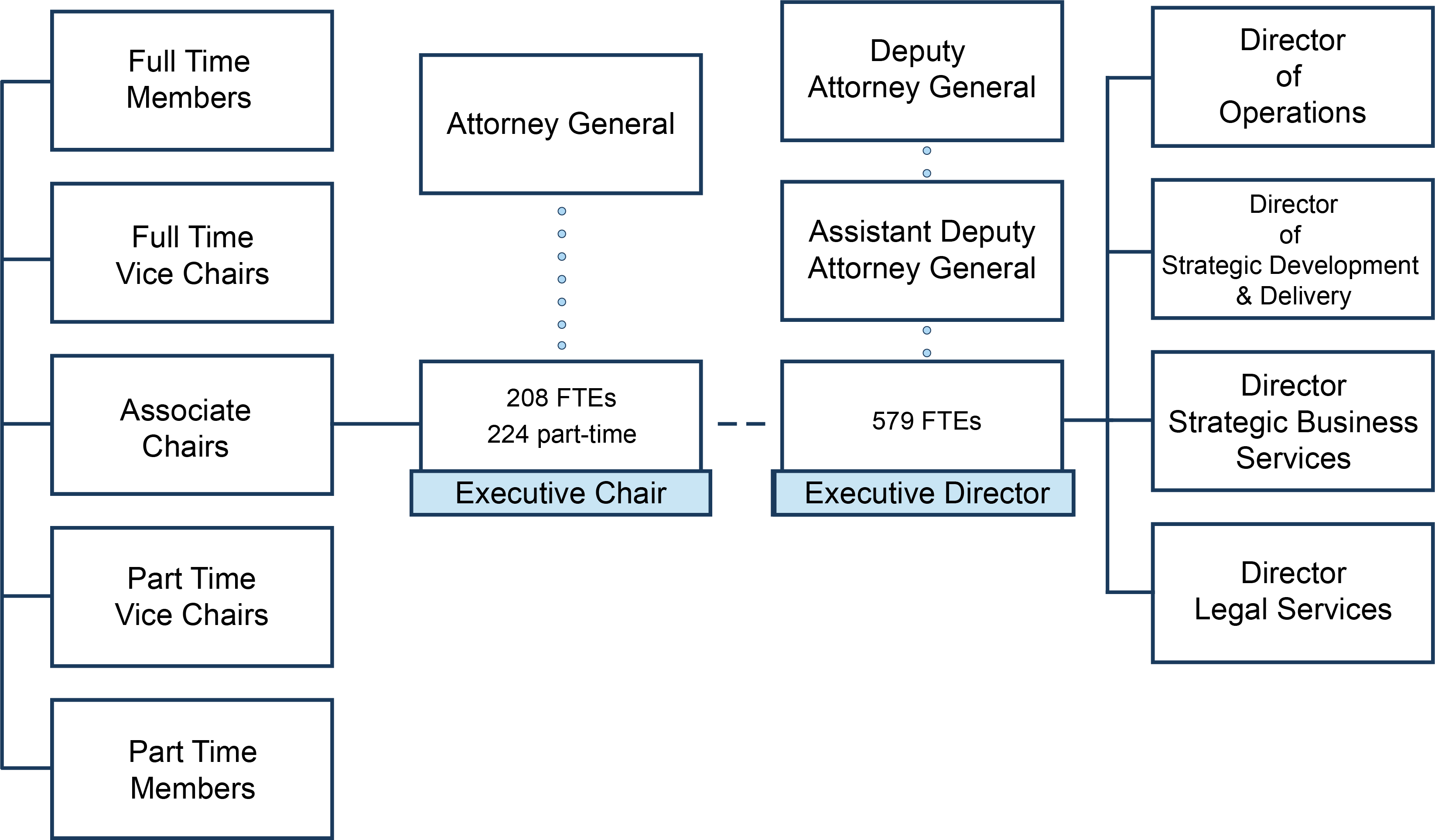
Tribunals Ontario has a full-time equivalent (FTE) allocation of 579 staff and 208 full-time adjudicator positions. This allocation includes the addition of 30 FTEs in July 2025 (20 permanent staff FTEs and 10 full-time Order-in-Council (OIC) FTEs), allocated to assist with backlog reduction. In addition to the FTE allocation, Tribunals Ontario had a complement of 224 part-time adjudicators as of October 31, 2025.
The staff allocation at Tribunals Ontario includes FTEs within the following groups: Executive Management Group, Crown Counsel, Association of Law Officers of the Crown (ALOC), Management Compensation Plan (MCP), Association of Management, Administrative and Professional Crown Employees of Ontario (AMAPCEO), Ontario Public Service Employees Union (OPSEU) and Excluded.
Tribunals Ontario does not set its own compensation levels. Management and staff are covered by the OPS Compensation Directive. Compensation for OIC appointees is set by the Treasury Board and approved by the Cabinet. This is laid out in the Agencies and Appointments Directive.
Section 8: Information Technology (IT) / Electronic Service Delivery (ESD) Plan
Digital Automation Service
In 2025, Tribunals Ontario successfully launched a new Digital Automation Service across multiple tribunals and business units which aligns with Tribunals Ontario’s strategic direction. This marks a significant step forward in our digital transformation journey. Digital automation leverages technology to streamline tasks to reduce manual effort, improves accuracy and user experience. The initiative has generated strong interest across the organization, with automation champions being onboarded from tribunals and business areas to lead efforts within their respective teams. These champions will play a pivotal role in fostering a culture of innovation and digital enablement.
Through targeted pilot sessions, high-potential processes for automation were identified and a standardized Automation Scorecard to guide prioritization was introduced. To support sustainable adoption, a structured training program was developed and delivered, combining instructor-led sessions with self-paced modules to build foundational skills among our tech champions.
Looking ahead, we will expand the training program to ensure engagement with newly onboarded champions across all tribunals and business units. The Digital Delivery team will continue to provide expert consultation and troubleshooting to support teams in initiating and implementing automation for their selected processes. By the end of 2026, we aim to achieve a 30% reduction in manual effort for select processes capable of automation. The Digital Automation Service is a cornerstone of our modernization strategy, driving measurable improvements in efficiency, empowering staff, and enhancing the quality and timeliness of service delivery across Tribunals Ontario.
Accessible, Efficient, and Modern Forms for Better Service
Tribunals Ontario is addressing critical challenges with legacy forms, which are increasingly outdated and create barriers to access to justice. Current issues are that the forms do not work well with all browsers, there are not clear validations to support users in completing them accurately, and the process has too many steps which makes it frustrating for users.
To resolve these issues, Tribunals Ontario has launched a modernization initiative to deliver redesigned forms that meet the highest standards of security, accessibility and usability. These new forms will include:
- Step-by-step navigation tools: Complete one section at a time, leading naturally to the next.
- Only collect critical information needed to initiate an appeal or application.
- Validation tools: Help users complete the form correctly the first time.
- No software required: All forms are accessible directly through the website.
The first redesigned forms for CFSRB will be launched by the end of 25/26, marking the start of a broader transformation in service delivery.
Modernizing Case Management Systems for Operational Excellence and Long-Term Sustainability
Tribunals Ontario is implementing key initiatives to strengthen the reliability and efficiency of its Case Management Systems (CMSs) while reducing operational risk and stabilizing costs.
Tribunals Ontario is partnering with other ministries to deliver a next-generation digital case management system for tribunals that will replace outdated platforms with a streamlined, end-to-end solution. This multi-year initiative aims to enhance efficiency, improve user experience, and support modern service delivery.
Backup and Archiving Solution: Tribunals Ontario is implementing a secure backup and archiving solution to protect critical case data from system failures, cyber threats, and accidental loss. This ensures business continuity, compliance with legal requirements, and long-term access to historical case information for appeals and reviews. Archiving also improves system performance by moving inactive cases out of the active environment, optimizing storage and enhancing overall efficiency.
Cloud Migration for HRTO Case Management System: Tribunals Ontario is transitioning HRTO’s CMS to a cloud-based platform to improve performance and scalability. This move sustains the application through essential upgrades until a new CMS is deployed, enabling growth without significant infrastructure investment.
Legacy System Enhancement Framework: Tribunals Ontario has established a standardized framework to maintain and enhance legacy CMSs over the next 3–5 years. This approach ensures systems remain reliable, secure, and efficient, supports backlog reduction, improves user experience, and aligns with organizational priorities through executive oversight.
These initiatives will reduce risk, preserve data integrity, improve service delivery, stabilize costs and position Tribunals Ontario for a smooth transition to next-generation case management solutions.
Section 9: Communication Plan
Tribunals Ontario is committed to providing fair, efficient, and timely dispute resolution services for users who come before our 12 tribunals. The Communications Unit helps the tribunals establish and maintain strong and open communications with the public, users, and stakeholders by delivering information in a clear, easy-to-understand and transparent manner.
To do this, Tribunals Ontario:
- Develops and distributes information and resources in plain language quickly and efficiently to help the public and stakeholders.
- Reviews and updates information on the Tribunals Ontario website to comply with OPS guidelines for Accessibility for Ontarians with Disabilities Act (AODA) and French Language Services (FLS) requirements.
- Informs the public, self-represented parties, and stakeholders about tribunal functions, rules, practices, and new initiatives.
- Communicates and engages regularly with staff and adjudicators about strategic and operational updates so they are well-informed.
The Communications Unit supports the Executive Office (EO) and provides communication services such as strategic communications planning, internal communications, media relations, issues management, website management, and content development, and supports tribunal initiatives and stakeholder engagement activities.
Communications Approach
Tribunals Ontario is a digital-first organization, and all our tribunals are successfully using digital communications tools to inform and engage with service users, stakeholders, and the public.
The Tribunals Ontario website and the Tribunals Ontario Contact Centre are the primary ways our users and stakeholders connect with us for information. The website is typically the first point of contact for our users when they are looking for information.
To ensure compliance with our French Language Services policy, all public-facing communication is available in French and English simultaneously.
Internal Communications
Tribunals Ontario continues to foster a people-first organization and culture with a strong commitment to diversity, equity, and inclusion and to transparency and employee engagement and empowerment.
Internally, Tribunals Ontario utilizes several communication tools and products, including:
- Newsletters - Monthly newsletters are distributed organization-wide and communicate Executive Office (EO) messages, operational and project updates, professional development opportunities for staff and adjudicators, upcoming events, and interesting information about various divisions within the organization to help foster increased employee engagement, recognition of great work, and to drive a one-organization culture.
- TO Learns – Launched in 2025, this monthly bulletin features a curated list of upcoming OPS and Tribunals Ontario learning and development opportunities, making it easier for staff and adjudicators to find and register for relevant courses.
- Intranet - Tribunals Ontario's internal website provides information and resources to all staff and adjudicators including tips and guides on remote work, learning and development opportunities, videos of past townhalls, a collection of all of communications from the EO, and much more.
- Townhalls - Regular townhall sessions are hosted by the EO and individual tribunals to provide key updates and information on new initiatives, operational updates, and employee opportunities. All staff and adjudicators are provided an opportunity to ask questions.
- Employee engagement - Informal sessions between the EO and individual tribunals or business units are held at least once a year to provide an open-forum dialogue where staff and adjudicators have opportunities to ask questions or pitch ideas in a smaller group setting.
- Memos - Frequent tribunal and/or EO memos are sent to staff and adjudicators regarding upcoming events, operational updates, or to highlight days of significance to employees.
- Social events - Several virtual and in-person social events are held to build connections with colleagues and boost employee morale.
Stakeholder Engagement and Public Consultation
Tribunals Ontario recognizes the importance of engaging with stakeholders to understand the needs and perspectives of people who come before the tribunals and the impacts that operational and program changes may have on how they interact with the tribunals.
Tribunals Ontario tracks stakeholder engagement across all of its tribunals and continues to work on creating a harmonized approach to stakeholder communications and engagement. As part of stakeholder engagement, our tribunals consult on a wide variety of topics, including tribunal policies, rules, process design reviews and new programs and initiatives. By having an open dialogue with stakeholders, tribunals can better understand the impacts of operational and program changes.
Tribunals Ontario's Public Consultation Policy outlines our approach to consultation and stakeholder engagement.
In 2024 and 2025, the HRTO consulted on updates to its Rules of Procedure to support operational changes that introduced mandatory mediation and updated its processes for managing adjournments, rescheduling and extension requests. These changes created a more predictable and consistent tribunal process and helped ensure that cases proceed in a more timely manner, improving overall efficiency. The HRTO will continue to consult on proposed changes to its Rules of Procedure in 2026.
Several tribunals meet on a regular basis with their key stakeholders to discuss and share information on streamlining processes, scheduling practices, service timelines and more. Some examples include:
- The ACRB continued to have positive engagement with the Chief Animal Welfare Inspector and Animal Welfare Services.
- The ARB meets quarterly with stakeholders through its Appeals Management Committee, which includes representatives from the Municipal Property Assessment Corporation, municipalities, law firms and tax agent firms.
- The FSC meets regularly with the Ontario Fire Marshal to review and provide operational and adjudicative updates.
- The HRTO meets with the Human Rights Legal Support Centre and the Ontario Human Rights Commission on a quarterly basis.
- The LTB holds an annual townhall with its stakeholders to provide operational and adjudicative updates.
- The OPB meets with various Federal & Provincial Parole Boards on a quarterly basis.
- The SBT meets with stakeholders regularly to discuss operational items and holds monthly collaboration meetings with the Ministry of Children, Community and Social Services to share information regarding new processes.
In addition to tribunal engagement sessions and consultations, the Executive Chair, Executive Director, Associate Chairs, Senior Management and Legal Counsel regularly connect with stakeholder groups by participating in virtual or in-person speaking engagements. They also provide updates through written communications, including letters or memos. Tribunals Ontario will continue engaging with stakeholders to have productive conversations.
Tribunals Ontario Website
Tribunals Ontario is a digital-first organization and therefore recognizes the importance of providing direct access for users seeking information and resources quickly and efficiently. One of the ways the tribunals do that is through a modern and easy-to-navigate website containing information and resources on all 12 tribunals.
In 2024, Tribunals Ontario modernized its website to provide a simpler, more intuitive, user-friendly online experience for all users. The modernized website makes it easier for users to find the information they are looking for and help them better understand the application process. It has a modern look and feel, and is simple and intuitive to navigate. The content on the website has been reviewed for plain language and accessibility. "Call to action" buttons are featured on most pages and are designed to help users navigate the tribunal process more independently.
The website is fully accessible and responsive from a variety of devices, including desktops, tablets, and smartphones, and compatible with the most commonly used web browsers, such as Google Chrome, Microsoft Edge, Safari, and Firefox. We continue to monitor how our users interact with the website through our user survey to identify further opportunities for improvement.
Work is underway to further improve the readability of the Tribunals Ontario website by using plain language principles. Plain language principles are essential to ensure clear communication and understanding between the organization and its users. Plain language ensures that messages are clear, concise, and easy to understand, saving time for staff and users by reducing errors in submissions, and reducing the number of questions users may have for the organization.
In addition to the new website, Tribunals Ontario has two other online digital tools that provide online information and services to users: Navigate Tribunals Ontario and the Tribunals Ontario Portal.
Media Relations
Tribunals Ontario continues to provide information to the media in a transparent, effective, and timely manner. To help promote and maintain positive working relationships with journalists, Tribunals Ontario continues to share copies of certain documents and relay file details with reporters and media outlets who express interest in particular cases.
Tribunals Ontario continues to facilitate Media 101 training sessions with staff and adjudicators to ensure they understand the organization's media policy and protocol. Twice a year, the Communications Unit internally distributes written reminders/protocol for what adjudicators and staff should do if they are contacted by a member of the media.
Section 10: Diversity and Inclusion Plan
Tribunals Ontario is committed to fostering and sustaining a safe, respectful, and inclusive workplace – one that is diverse, equitable, anti-racist, accessible, and free from harassment and discrimination. Through deliberate action, the organization is working to identify, prevent, and remove systemic barriers to ensure the best possible outcomes for both employees and the individuals who access our services.
In April 2025, Tribunals Ontario launched its 2025–2026 Diversity, Equity, and Inclusion (DEI) Strategy anchored in three core goals:
- Diversity of Thought and Experience: Build anti-racism competency, capacity, and awareness across the organization.
- Inclusive Leadership and Culture: Foster a collaborative, flexible, and fair workplace that enables all employees to contribute to their fullest potential, while developing leaders who model inclusive and respectful behaviours.
- Diverse Talent: Strengthen access to employment opportunities for Indigenous, Black, racialized, 2SLGBTQIA+ individuals, and persons with disabilities.
The strategy is supported by three dedicated Working Groups, each responsible for developing and implementing initiatives aligned with the strategy’s core objectives.
Key Actions in 2025 Included:
- Launch of the 2025–2026 DEI Strategy.
- Completion of a call-out for Working Group members, now fully staffed to support implementation.
- Continued recognition of days of significance to promote education through lived experiences.
- Highlighting DEI learning opportunities in the monthly Learning Calendar.
- Introduction of a quarterly DEI Book Nook to encourage dialogue and celebrate diverse voices.
- Delivery of Implicit Bias Training for all new employees and full-time adjudicators.
- Integration and introduction of our DEI principles and strategy into the Tribunals Ontario Corporate Welcome and Orientation Program.
- Hosted a virtual tour of the former Mohawk Institute Residential School in honour of the National Day for Truth and Reconciliation.
- Incorporation of DEI principles into succession planning, with a focus on identifying potential successors from underrepresented groups.
Upcoming Initiatives:
- Implementing designated spaces in Tribunals Ontario locations for reflection, meditation, or prayer during office hours.
- Curated materials to build awareness, support leadership, and address systemic issues.
- DEI Measurement and Reporting Framework to track progress, including baselines, targets, and key performance indicators.
Employee Engagement
As part of our commitment to building a diverse, equitable and inclusive workforce, Tribunals Ontario has committed to key priority areas of focus based on the results from the 2024 employee survey, informing the establishment of an Employee Engagement Action Plan.
This Action Plan aims to address the following priorities:
- Mental Health, including workload.
- Recognition.
- Recruitment and Career Progression.
Notable actions in 2025 include:
- Delivered five sessions as part of a comprehensive Health and Wellness initiative, covering a range of mental health topics in collaboration with GreenShield.
- Continuation of the Tribunals Ontario Reverse Job Shadow Program where each manager was paired with an employee to observe the typical functions, processes, and procedures the employee undertakes in their role. The intention of the program is to expose managers to the work done across the organization, providing an opportunity to broaden their perspective, gain insight and appreciation, and expand their thinking on solutions to key challenges employees may be facing in their daily work.
- A Tribunals Ontario Job Shadow Program will be launched in 2026 where staff will have the opportunity to observe the daily responsibilities of fellow employees in roles they may be interested in pursuing. Building on the success of the Reverse Job Shadow Program, this new program is designed to enhance role awareness, foster new insights, and encourage networking across the organization.
- Tribunals Ontario Corporate Welcome and Orientation Program continued for all new staff. This program aims to strengthen Tribunals Ontario's onboarding practices and orientation process, to ensure new employees are set up for success in their new roles and careers, and to ensure that all staff feel welcomed within the organization.
- "A Day in the Life" sessions were hosted by the Employee Engagement Committee. This is an ongoing learning series that provides an overview of each tribunal, board, and functional area of the organization, exposing staff and adjudicators to the different work, priorities, projects, and initiatives across Tribunals Ontario.
- Second Annual Tribunals Ontario Awards & Recognition Program was launched in September 2025 to formally recognize and champion outstanding work of staff and adjudicators in the organization. The program is guided by accessible and fair principles and is aligned with Tribunals Ontario's mission, values, and priorities to help build a culture of mutual respect, reward, engagement, and quality of work.
Section 11: Multi-Year Accessibility Plan
Tribunals Ontario is committed to treating all people in a way that allows them to maintain their dignity and independence. We believe in inclusion and equal opportunity. We are committed to meeting the needs of people with disabilities in a timely manner and will do so by preventing and removing barriers to accessibility, providing accommodations as necessary, and meeting accessibility requirements under the Accessibility for Ontarians with Disabilities Act, 2005 (AODA).
Tribunals Ontario delivers administrative justice in a fair, independent, effective and efficient manner. We promote public confidence through integrity and excellence, and by being accessible, accountable, and responsive.
The 2025-2028 Tribunals Ontario Multi-Year Accessibility Plan (MYAP) is organized around the following five key initiatives:
- Inclusive Employment
- Equitable Customer Service
- Inclusive Digital Information and Communications
- Infrastructure – Barrier-free Tribunals Ontario Facilities
- Public Spending – Accessible Procurements
As outlined in the MYAP, Tribunals Ontario will focus on ensuring that our services are accessible. That means:
- Persons with disabilities receive quality services in a timely manner.
- Information and communications are available in accessible formats to all Tribunals Ontario employees, adjudicators, clients and stakeholders.
- Persons with disabilities can participate fully and meaningfully in the dispute resolution process.
- There is barrier-free accessibility into and out of Tribunals Ontario facilities and other facilities that Tribunals Ontario may use from time to time to host proceedings.
- Tribunals Ontario employees and adjudicators continually identify barriers to accessibility and actively seek solutions to prevent or remove them.
In establishing and maintaining our MYAP for 2025-2028, Tribunals Ontario commits to ensuring:
- Candidates for employment and Tribunals Ontario employees with disabilities have the necessary supports to join, work effectively, experience career growth, and have opportunities for learning, development, and career progression.
- Members of the public of all abilities receive seamless, dignified, and equitable access to barrier-free services from well-equipped front-line Tribunals Ontario employees and adjudicators.
- Members of the public and Tribunals Ontario employees and adjudicators of all abilities are provided with equitable access to Tribunals Ontario digital information, products, and services that meet accessibility requirements.
- Tribunals Ontario facilities incorporate inclusive design practices and technologies to make everyone of all abilities feel welcome.
- Accessibility is effectively integrated at each stage of Tribunals Ontario procurement processes to ensure that no barriers for persons with disabilities are created using public dollars.
As Tribunals Ontario continues to identify, prevent and remove accessibility barriers, we will monitor and report on the progress and results in meeting our commitments.
Tribunals Ontario Accessibility Progress (2020–2024)
Tribunals Ontario has consistently advanced accessibility across the organization. Key achievements under the previous multi-year accessibility plan include:
Customer Service
- Collaborated with employees, adjudicators, clients, and stakeholders to accommodate personal support services for communication, mobility, personal care, or medical needs.
- Modernized the contact centre with technology upgrades, including a plain-language Interactive Voice Response (IVR) system that is easier to navigate and understand.
Access to Digital Services
- Adopted video and telephone hearings as the default, with digital literacy and technical supports for users.
- Redesigned the Tribunals Ontario website as a single access point for all boards and tribunals, offering a simpler, more intuitive user experience.
- Revised website content using plain language best practices.
- Ensured all online content is posted in HTML format—the most universally accessible standard—and compliant with AODA requirements.
- Improved website accessibility to meet Web Content Accessibility Guidelines (WCAG) Level AA standards.
- Converted existing PDF and Word documents to accessible HTML, with ongoing work continuing into 2025 and going forward.
- Expanded online services, including electronic filing, email submissions, and standardized email communication across tribunals.
- Developed an online payment portal for convenient transactions.
- Implemented a practice of posting service disruption notices online, including reasons, duration, and alternative options.
Employment, Diversity & Inclusion
- Promoted an inclusive, respectful, and accessible workplace through initiatives in recruitment, leadership development, succession planning, coaching, mentoring, and health and wellness resources.
Policies & Practices
- Aligned with the OPS digital government mandate to move services online, improving customer experience through user-centered design and feedback.
- Continued identifying and addressing barriers in Tribunals Ontario spaces.
Accommodations
- Provided case-by-case accommodations for Ontario Human Rights Code needs or procedural fairness concerns, including technology access and in-person hearings.
- Launched an Access Terminals Program to support parties with technology challenges, offering computers, internet, and phones at flexible locations.
- Introduced a Free Phone Program for users needing telephone access for hearings, including basic cell phones or top-up vouchers.
- Ensured venues in remote areas met accessibility standards and documented them in a centralized database.
- Improved accommodation information for parties, including updates to request forms and creation of a plain-language Accommodation Information Sheet sent early in the process.
Procurement
- Continued communicating accessibility obligations to vendors, addressing non-compliance through remediation or disqualification.
Section 12: Three-year Financial Plan
| Fiscal Year 2025-26 | |||
|---|---|---|---|
| Operating Budget | 2025-26 Budget Allocation | 2025-26 Q2 Forecast | Variance Surplus/ (Pressures) |
| Salaries and Wages | |||
| Salaries and Wages | $68,867,000 | $69,541,425 | $(674,425) |
| Benefits | $8,850,400 | $10,778,921 | $(1,928,521) |
| Other Direct Operating Expense (ODOE) | |||
| Transportation & Communications | $2,650,400 | $1,259,254 | $1,391,146 |
| Services | $14,880,300 | $23,496,149 | $(8,615,849) |
| Supplies & Equipment | $542,600 | $499,627 | $42,973 |
| Sub-total Operating | $95,790,700 | $105,575,376 | $(9,784,676) |
| Recoveries | $(437,300) | $(300,000) | $(137,300) |
| Total Operating | $95,353,400 | $105,275,376 | $(9,921,976) |
| Revenue | 2025-26 Budget Allocation | 2025-26 Q2 Forecast | Revenue Increase / (Decrease) |
| Filing Fees and Sales | $15,853,300 | $17,727,900 | $1,874,600 |
| Reimbursement of Expenditure LAT-AABS | $17,723,100 | $16,202,100 | $(1,521,000) |
| Fiscal Years 2026-27 to 2028-29 | |||
|---|---|---|---|
| Operating Budget | 2026-27 Budget Allocation | 2027-28 Budget Allocation | 2028-29 Budget Allocation |
| Salaries and Wages | $63,977,800 | $62,122,200 | $62,122,200 |
| Benefits | $8,141,500 | $7,858,800 | $7,858,800 |
| Other Direct Operating Expense (ODOE) | |||
| Transportation & Communications | $2,650,400 | $2,650,400 | $2,650,400 |
| Services | $14,000,200 | $13,666,000 | $13,666,000 |
| Supplies & Equipment | $542,600 | $542,600 | $542,600 |
| Sub-total Operating | $89,312,500 | $86,840,000 | $86,840,000 |
| Recoveries | $(437,300) | $(437,300) | $(437,300) |
| Total Operating | $88,875,200 | $86,402,700 | $86,402,700 |
| Revenue | 2026-27 Budget Allocation | 2027-28 Budget Allocation | 2028-29 Budget Allocation |
| Filing Fees and Sales | $16,798,500 | $16,798,500 | $16,798,500 |
| Reimbursement of Expenditure LAT-AABS | $17,626,300 | $17,626,300 | $17,626,300 |
Section 13: Key Performance Indicators and Targets
Tribunals Ontario Business Plan Key Performance Indicators
Tribunals Ontario is tracking the performance of our tribunals against nine Key Performance Indicators (KPIs):
- The volume of in-person, electronic and written hearing events held across all tribunals for English files.
- Number of eligible accommodation requests granted (in whole or in-part) across all tribunals.
- Percentage that tribunals meet hearing event date scheduling targets.
- Percentage that tribunals meet decision issuance standards.
- Percentage of cases within the case lifecycle across all tribunals for English files.
- Percentage of cases that are resolved through alternative dispute resolution (in whole or in-part) across all tribunals.
- Percentage that tribunals meet time to proceed to the initial hearing event targets.
- The volume of in-person, electronic and written hearing events held across all tribunals for French or bilingual files.
- Percentage of cases within the case lifecycle across all tribunals for French or bilingual files.
Tribunals Ontario recognizes that some tribunals and boards have experienced challenges that have caused them to fall short of meeting some of their service targets.
Efforts have been underway to address the factors that contribute to the delays and backlogs. The tribunals and boards experiencing service delays have continued to implement strategies to improve services by increasing the number of adjudicators and enhancing the efficiency of caseload management. These plans include an aggressive recruitment framework to ensure recommendations to renew or fill vacant adjudicator positions are processed in a timely manner, robust training plans for new adjudicators, and procedure reviews to identify and implement efficiencies with respect to application processing, scheduling hearings and issuing decisions.
The first chart below is a roll-up of all 13 tribunals' KPIs. The 13 tribunals include the OCPC KPIs, as the OCPC was not dissolved until September 1, 2025 (Q2). The Tribunals Ontario- wide KPIs were calculated by taking an evenly weighted average across all tribunals that are reporting on that KPI (e.g., if 13 tribunals report on the KPI, then the weight would be 7.69% per tribunal). In certain situations, tribunals may not be added to the weighted average; specifically, if they did not receive a case in the period being reported (noted as N/A) and/or if there are technical limitations with providing the data (noted as TBD). The table below shows how Tribunals Ontario is doing as an organization. Following the Tribunals Ontario table, we have similar tables for each of our tribunals.
Tribunals Ontario KPI Roll-Up Stats
| Tribunals Ontario Key Performance Indicators Roll-Up (2025-26) | ||||
|---|---|---|---|---|
| Key Performance Indicators | Actuals (Q1 and Q2) | Target | ||
| # | % | 2025-26 | 2026-27 2027-28 2028-29 |
|
| Volume of in-person, electronic and written hearing events held by Tribunals Ontario in English (total) | 60,550 | N/A | N/A | N/A |
| In-Person Hearing Events | 30 | N/A | N/A | N/A |
| Electronic Hearing Events | 58,312 | N/A | N/A | N/A |
| Written Hearing Events | 2,208 | N/A | N/A | N/A |
| Volume of in-person, electronic and written hearing events held by Tribunals Ontario in French / Bilingual (total) | 588 | N/A | N/A | N/A |
| In-Person Hearing Events | - | N/A | N/A | N/A |
| Electronic Hearing Events | 573 | N/A | N/A | N/A |
| Written Hearing Events | 15 | N/A | N/A | N/A |
| Number of eligible accommodation requests granted (in whole or in-part) by Tribunals Ontario | 840 | N/A | N/A | N/A |
| Percentage that Tribunals Ontario meets their hearing event date scheduling target | 52,778 | 96% | 80% | 80% |
| Percentage that Tribunals Ontario meets their time to proceed to the initial hearing event target | 9,901 | 95% | 80% | 80% |
| Percentage that Tribunals Ontario meets their decision issuance standard | 36,885 | 93% | 80% | 80% |
| Percentage of cases within the case lifecycle for Tribunals Ontario for English files* | 34,898 | 87% | 80% | 80% |
| Percentage of cases within the case lifecycle for Tribunals Ontario for French / Bilingual files** | 274 | 77% | 80% | 80% |
| Percentage of cases that are resolved through alternative dispute resolution (in whole or in-part) within Tribunals Ontario | 11,646 | 42% | N/A | N/A |
* This KPI does not include the ARB data, as the ARB reports on cases resolved during the case lifecycle.
** 11 of the 13 tribunals have no backlogs. Given the high volume of cases at the HRTO and LTB, the backlogs at these two tribunals have a disproportionate influence on the Tribunals Ontario aggregate rolled-up statistics, particularly in relation to FLS files. The backlogs at the HRTO and LTB continue to decline, and they are actively working to improve their processing timelines.
Animal Care Review Board
| Tribunals Ontario Key Performance Indicators (Q1 and Q2 25-26 Data) | ||||
|---|---|---|---|---|
| Animal Care Review Board | Actuals (Q1 and Q2 2025-26) | Target | ||
| # | % | 2025-26 | 2026-27 2027-28 2028-29 |
|
| Volume of in-person, electronic and written hearing events held at the ACRB in English | 280 | N/A | N/A | N/A |
| In-Person Hearing Events | 0 | N/A | N/A | N/A |
| Electronic Hearing Events | 278 | N/A | N/A | N/A |
| Written Hearing Events | 2 | N/A | N/A | N/A |
| Volume of in-person, electronic and written hearing events held at the ACRB in French / Bilingual | 5 | N/A | N/A | N/A |
| In-Person Hearing Events | 0 | N/A | N/A | N/A |
| Electronic Hearing Events | 5 | N/A | N/A | N/A |
| Written Hearing Events | 0 | N/A | N/A | N/A |
| Number of eligible accommodation requests granted (in whole or in-part) by the ACRB | 4 | N/A | N/A | N/A |
| Percentage of hearings scheduled within five business days after the receipt of a completed appeal | 167 | 98% | 95% | 95% |
| Percentage that the ACRB proceeds to a first Held Hearing Event within 10 business days from the application/appeal completed/perfected date | 169 | 99% | 80% | 80% |
| Decisions issued within 60 calendar days from the conclusion of a hearing | 48 | 95% | 80% | 80% |
| Percentage of cases within the three-month case lifecycle for English applications at the ACRB | 60 | 92% | 80% | 80% |
| Percentage of cases within the three-month case lifecycle for French/Bilingual applications at the ACRB | 2 | 100% | 80% | 80% |
| Percentage of resolved cases through alternate dispute resolution (in whole or in-part) within the ACRB | 88 | 42% | N/A | N/A |
Assessment Review Board
| Tribunals Ontario Key Performance Indicators (Q1 and Q2 25-26 Data) | ||||
|---|---|---|---|---|
| Assessment Review Board | Actuals (Q1 and Q2 2025-26) | Target | ||
| # | % | 2025-26 | 2026-27 2027-28 2028-29 |
|
| Volume of in-person, electronic and written hearing events held at the ARBin English | 164 | N/A | N/A | N/A |
| In-Person Hearing Events | - | N/A | N/A | N/A |
| Electronic Hearing Events | 147 | N/A | N/A | N/A |
| Written Hearing Events | 17 | N/A | N/A | N/A |
| Volume of in-person, electronic and written hearing events held at the ARB in French / Bilingual | - | N/A | N/A | N/A |
| In-Person Hearing Events | - | N/A | N/A | N/A |
| Electronic Hearing Events | - | N/A | N/A | N/A |
| Written Hearing Events | - | N/A | N/A | N/A |
| Number of eligible accommodation requests granted (in whole or in-part) by the ARB | 1 | N/A | N/A | N/A |
| Percentage that the hearing event month is assigned within 90 days of a perfected appeal | 3,039 | 100% | 85% | 85% |
| Decisions issued within 60 calendar days from the conclusion of a hearing | 2,783 | 94% | 85% | 85% |
| Percentage of summary appeals resolved within 40 weeks following the commencement date for ARB | 352 | 85% | 85% | 85% |
| Percentage of general appeals resolved within 135 weeks following the commencement date for ARB | 1,936 | 96% | 85% | 85% |
Notes:
For the ARB, the decisions issued KPI includes all hearing and non-hearing decisions resulting from ARB proceedings.
Child and Family Services Review Board
| Tribunals Ontario Key Performance Indicators (Q1 and Q2 25-26 Data) | ||||
|---|---|---|---|---|
| Child and Family Services Review Board | Actuals (Q1 and Q2 2025-26) | Target | ||
| # | % | 2025-26 | 2026-27 2027-28 2028-29 |
|
| Volume of in-person, electronic and written hearing events held at the CFSRB in English | 60 | N/A | N/A | N/A |
| In-Person Hearing Events | 1 | N/A | N/A | N/A |
| Electronic Hearing Events | 41 | N/A | N/A | N/A |
| Written Hearing Events | 18 | N/A | N/A | N/A |
| Volume of in-person, electronic and written hearing events held at the CFSRB in French / Bilingual | 0 | N/A | N/A | N/A |
| In-Person Hearing Events | 0 | N/A | N/A | N/A |
| Electronic Hearing Events | 0 | N/A | N/A | N/A |
| Written Hearing Events | 0 | N/A | N/A | N/A |
| Number of eligible accommodation requests granted (in whole or in-part) by the CFSRB | 3 | N/A | N/A | N/A |
| Percentage of hearings scheduled within 60 calendar days from the eligibility date of their applications | 18 | 89% | 80% | 80% |
| Percentage that the CFSRB proceeds to a first held hearing event within 7 days for introductory hearings from the application receipt date | 41 | 71% | 80% | 80% |
| Decisions issued within 45 calendar days from the conclusion of a hearing | 34 | 91% | 80% | 80% |
| Percentage of cases within the seven-month case lifecycle for CFSRB for English files | 16 | 100% | 80% | 80% |
| Percentage of cases within the seven-month case lifecycle for French/Bilingual applications at the CFSRB | 0 | N/A | 80% | 80% |
| Percentage of cases that are resolved through alternative dispute resolution (in whole or in-part) within the CFSRB | 55 | 75% | N/A | N/A |
Notes:
*The CFSRB‘s previously reported KPIs under this category captured the number of CFSRB applications resolved within the target seven-month calendar day case lifecycle. In this report and moving forward, the data in this category will capture the number of active cases within the CFSRB‘s seven-month calendar day case lifecycle.
For the time to proceed to a first held hearing event KPI, the CFSRB has two hearing types, as indicated in the chart above. The first is a pre-hearing mediation that has the service standard of 40 days and refers to applications filed about complaints against a Children’s Aid Society (s. 119/120). The second is an introductory hearing that has the service standard of 7 days and this applies to applications submitted about the proposed removal of a child from a foster home or review of an adoption refusal (s. 109 / 192).
s.119/120: Application about Complaints Against a Children's Aid Society
s.109: Application about the Proposed Removal of a Child from a Foster Home
s.192: Application for Review of an Adoption Refusal
Custody Review Board
| Tribunals Ontario Key Performance Indicators (Q1 and Q2 25-26 Data) | ||||
|---|---|---|---|---|
| Custody Review Board | Actuals (Q1 and Q2 2025-26) | Target | ||
| # | % | 2025-26 | 2026-27 2027-28 2028-29 |
|
| Volume of in-person, electronic and written hearing events held at the CRB in English | 68 | N/A | N/A | N/A |
| In-Person Hearing Events | 0 | N/A | N/A | N/A |
| Electronic Hearing Events | 68 | N/A | N/A | N/A |
| Written Hearing Events | 0 | N/A | N/A | N/A |
| Volume of in-person, electronic and written hearing events held at the CRB in French / Bilingual | 1 | N/A | N/A | N/A |
| In-Person Hearing Events | 0 | N/A | N/A | N/A |
| Electronic Hearing Events | 1 | N/A | N/A | N/A |
| Written Hearing Events | 0 | N/A | N/A | N/A |
| Number of eligible accommodation requests granted (in whole or in-part) by the CRB | 0 | N/A | N/A | N/A |
| Percentage that the CRB proceeds to a first Held Hearing Event within 24 hours from the application receipt date | 69 | 100% | 80% | 80% |
| Recommendations issued within 30 calendar days from the conclusion of a hearing | 33 | 100% | 100% | 100% |
| Percentage of cases within the 30-day case lifecycle for CRB in English | 9 | 100% | 100% | 100% |
| Percentage of cases within the 30-day case lifecycle for French/Bilingual applications at the CRB | 0 | N/A | 80% | 80% |
Notes:
- The CRB does not hold hearings, they conduct reviews and issue recommendations. As such, instead of reporting on decisions issued from the conclusion of a hearing, they are reporting on the recommendations issued from the conclusion of a review.
- Due to the CRB conducting reviews and not hearings, they will not be reporting on the hearing event date scheduling target KPI.
- The CRB does not report on matters related to alternative dispute resolution (ADR) as such activities fall outside the scope of its legislative mandate.
- The CRB‘s previously reported KPIs under this category captured the number of CRB applications resolved within the target 30-day case lifecycle. In this report and moving forward, the data in this category will capture the number of active cases within the CRB‘s 30-day case lifecycle.
Fire Safety Commission
| Tribunals Ontario Key Performance Indicators (Q1 and Q2 25-26 Data) | ||||
|---|---|---|---|---|
| Fire Safety Commission | Actuals (Q1 and Q2 2025-26) | Target | ||
| # | % | 2025-26 | 2026-27 2027-28 2028-29 |
|
| Volume of in-person, electronic and written hearing events held at the FSC in English | 37 | N/A | N/A | N/A |
| In-Person Hearing Events | 0 | N/A | N/A | N/A |
| Electronic Hearing Events | 29 | N/A | N/A | N/A |
| Written Hearing Events | 8 | N/A | N/A | N/A |
| Volume of in-person, electronic and written hearing events held at the FSC in French / Bilingual | 0 | N/A | N/A | N/A |
| In-Person Hearing Events | 0 | N/A | N/A | N/A |
| Electronic Hearing Events | 0 | N/A | N/A | N/A |
| Written Hearing Events | 0 | N/A | N/A | N/A |
| Number of eligible accommodation requests granted (in whole or in-part) by the FSC | 0 | N/A | N/A | N/A |
| Percentage of hearings scheduled within 60 calendar days of receipt of a completed appeal | 22 | 100% | 80% | 80% |
| Percentage that the FSC proceeds to a first Held Hearing Event within 60 calendar days from the application/appeal completed/perfected date | 22 | 100% | 80% | 80% |
| Decisions issued within 60 calendar days from the conclusion of a hearing | 4 | 100% | 80% | 80% |
| Percentage of cases within the six-month case lifecycle for English applications at the FSC | 7 | 100% | 80% | 80% |
| Percentage of cases within the six-month case lifecycle for French/Bilingual applications at the FSC | 0 | N/A | 80% | 80% |
| Percentage of cases resolved through alternate dispute resolution (in whole or in-part) within the FSC | 22 | 51% | N/A | N/A |
Human Rights Tribunal of Ontario
| Tribunals Ontario Key Performance Indicators (Q1 and Q2 25-26 Data) | ||||
|---|---|---|---|---|
| Human Rights Tribunal of Ontario | Actuals (Q1 and Q2 2025-26) | Target | ||
| # | % | 2025-26 | 2026-27 2027-28 2028-29 |
|
| Volume of in-person, electronic and written hearing events held at the HRTO in English | 3,257 | N/A | N/A | N/A |
| In-Person Hearing Events | 0 | N/A | N/A | N/A |
| Electronic Hearing Events | 2,207 | N/A | N/A | N/A |
| Written Hearing Events | 1,050 | N/A | N/A | N/A |
| Volume of in-person, electronic and written hearing events held at the HRTO in French / Bilingual | 64 | N/A | N/A | N/A |
| In-Person Hearing Events | 0 | N/A | N/A | N/A |
| Electronic Hearing Events | 49 | N/A | N/A | N/A |
| Written Hearing Events | 15 | N/A | N/A | N/A |
| Number of eligible accommodation requests granted (in whole or in-part) by the HRTO | 30 | N/A | N/A | N/A |
| Percentage of hearings scheduled within 180 calendar days from the date the application is ready to proceed to a hearing | 1,006 | 98% | 80% | 80% |
| Percentage of mediations scheduled within 150 calendar days from the date the parties agreed to mediation | 1,441 | 100% | 80% | 80% |
| Decisions issued within 6 months from the conclusion of a hearing | 635 | 85% | 80% | 80% |
| Percentage of cases within the 18-month case lifecycle for English applications at the HRTO | 4,301 | 54% | 80% | 80% |
| Percentage of cases within the 18-month case lifecycle for French / Bilingual applications at the HRTO | 68 | 53% | 80% | 80% |
| Percentage of cases that are resolved through alternative dispute resolution (in whole or in-part) within the HRTO | 948 | 46% | N/A | N/A |
Note:
- For the HRTO, the volume of hearing events KPI includes all hearings and mediations.
- For the HRTO, the decisions issued KPI includes only final decisions from pre-merit and merit hearings.
Landlord and Tenant Board
| Tribunals Ontario Key Performance Indicators (Q1 and Q2 25-26 Data) | ||||
|---|---|---|---|---|
| Landlord and Tenant Board | Actuals (Q1 and Q2 2025-26) | Target | ||
| # | % | 2025-26 | 2026-27 2027-28 2028-29 |
|
| Volume of in-person, electronic and written hearing events held at the LTB in English | 46,433 | N/A | N/A | N/A |
| In-Person Hearing Events | 22 | N/A | N/A | N/A |
| Electronic Hearing Events3 | 46,280 | N/A | N/A | N/A |
| Written Hearing Events | 131 | N/A | N/A | N/A |
| Volume of in-person, electronic and written hearing events held at the LTB in French / Bilingual | 466 | N/A | N/A | N/A |
| In-Person Hearing Events | - | N/A | N/A | N/A |
| Electronic Hearing Events | 466 | N/A | N/A | N/A |
| Written Hearing Events | - | N/A | N/A | N/A |
| Number of eligible accommodation requests granted (in whole or in-part) by the LTB | 734 | N/A | N/A | N/A |
| Percentage of hearings scheduled within of 35 business days for L1 and L9 applications and 40 business days for all other applications except for L5’s and A4’s from the application receipt date. | 34,603 | 78% | 80% | 80% |
| Decisions issued 20 business days for all applications except for L5’s and A4’s from the conclusion of the final hearing event. | 30,246 | 86% | 80% | 80% |
| Percentage of cases within the 90 calendar days case lifecycle for all applications except for L5’s and A4’s for English applications in the LTB. | 18,175 | 53% | 80% | 80% |
| Percentage of cases within the 90 calendar days case lifecycle for all applications except for L5’s and A4’s for French / Bilingual applications in the LTB. | 168 | 37% | 80% | 80% |
| Percentage of cases that are resolved through alternative dispute resolution (in whole or in-part) within the LTB. | 8,303 | 15% | N/A | N/A |
Note:
The definitions for each type of application referenced above are as follows:
- L1: Application to evict a tenant for non-payment of rent and to collect rent the tenant owes.
- L5: Application for an Above Guideline Increase
- L9: Application to Collect Rent the Tenant Owes
- A4: Application to Vary the Amount of a Rent Reduction
Licence Appeal Tribunal
| Tribunals Ontario Key Performance Indicators (Q1 and Q2 25-26 Data) | ||||
|---|---|---|---|---|
| Licence Appeal Tribunal | Actuals (Q1 and Q2 2025-26) | Target | ||
| # | % | 2025-26 | 2026-27 2027-28 2028-29 |
|
| Volume of in-person, electronic and written hearing events held at the LAT in English | 6,202 | N/A | N/A | N/A |
| In-Person Hearing Events | - | N/A | N/A | N/A |
| Electronic Hearing Events | 5,857 | N/A | N/A | N/A |
| Written Hearing Events | 345 | N/A | N/A | N/A |
| Volume of in-person, electronic and written hearing events held at the LAT in French / Bilingual | 8 | N/A | N/A | N/A |
| In-Person Hearing Events | - | N/A | N/A | N/A |
| Electronic Hearing Events | 8 | N/A | N/A | N/A |
| Written Hearing Events | - | N/A | N/A | N/A |
| Number of eligible accommodation requests granted (in whole or in-part) by the LAT | 6 | N/A | N/A | N/A |
| Percentage that the first hearing event (i.e., a case conference) is scheduled within 60 calendars days for the LAT-GS and 90 calendar days for the LAT-AABS from the receipt of a completed appeal / application | 7,853 | 99% | 80% | 80% |
| Percentage that the first hearing event (i.e., a case conference) is scheduled within 20 calendar days for the LAT-GS and 40 calendar days for the LAT-AABS from the receipt of a completed appeal / application | 5,360 | 100% | 80% | 80% |
| Decisions issued within 90 calendar days from the conclusion of a hearing | 224 | 76% | 80% | 80% |
| Percentage of cases within the 12-month case lifecycle for English application for the LAT | 7,959 | 89% | 80% | 80% |
| Percentage of cases within the 12-month case lifecycle for French / Bilingual applications for the LAT | 8 | 100% | 80% | 80% |
| Percentage of cases that are resolved through alternative dispute resolution (in whole or in-part) within the LAT | 2,051 | 22% | N/A | N/A |
Note:
- The LAT’s Decision Issuance KPI does not include case conference reports and orders, motion orders, or adjournment orders, which account for over 90% of total decisions for LAT. The statistics on decision issuance for the divisions within LAT (LAT-AABS and LAT-GS) are rolled up using a weighted average based on the number of decisions released across each division. The inclusion of decision types will be re-examined for a future iteration of the Tribunals Ontario KPI development.
Ontario Civilian Police Commission
| Tribunals Ontario Key Performance Indicators (Q1 and Q2 25-26 Data) | ||||
|---|---|---|---|---|
| Ontario Civilian Police Commission | Actuals (Q1 and Q2 2025-26) | Target | ||
| # | % | 2025-26 | 2026-27 2027-28 2028-29 |
|
| Volume of in-person, electronic and written hearing events held at the OCPC in English | 2 | N/A | N/A | N/A |
| In-Person Hearing Events | 0 | N/A | N/A | N/A |
| Electronic Hearing Events | 2 | N/A | N/A | N/A |
| Written Hearing Events | 0 | N/A | N/A | N/A |
| Volume of in-person, electronic and written hearing events held at the OCPC in French / Bilingual | 0 | N/A | N/A | N/A |
| In-Person Hearing Events | 0 | N/A | N/A | N/A |
| Electronic Hearing Events | 0 | N/A | N/A | N/A |
| Written Hearing Events | 0 | N/A | N/A | N/A |
| Number of eligible accommodation requests granted (in whole or in-part) by the OCPC | 0 | N/A | N/A | N/A |
| Percentage of hearings scheduled within 90 calendar days from the receipt of an application / appeal | - | N/A | N/A | N/A |
| Percentage that the OCPC proceeds to a first Held Hearing Event within 90 days from the application/appeal completed/perfected date | - | N/A | N/A | N/A |
| Decisions issued within 90 calendar days from the conclusion of a hearing | - | N/A | N/A | N/A |
| Percentage of cases within the 12-month (365 calendar days) case lifecycle for OCPC in English | - | N/A | N/A | N/A |
| Percentage of cases within the 12-month (365 calendar days) case lifecycle for OCPC in French / Bilingual | - | N/A | N/A | N/A |
Notes:
- The OCPC does not report on matters related to alternative dispute resolution (ADR) as such activities fall outside the scope of its legislative mandate.
- The OCPC was formally dissolved on September 1, 2025, therefore, there will be no further updates to these KPIs.
Ontario Parole Board
| Tribunals Ontario Key Performance Indicators (Q1 and Q2 25-26 Data) | ||||
|---|---|---|---|---|
| Ontario Parole Board | Actuals (Q1 and Q2 2025-26) | Target | ||
| # | % | 2025-26 | 2026-27 2027-28 2028-29 |
|
| Volume of in-person, electronic and written hearing events held at the OPB in English | 1,123 | N/A | N/A | N/A |
| In-Person Hearing Events | 0 | N/A | N/A | N/A |
| Electronic Hearing Events | 497 | N/A | N/A | N/A |
| Written Hearing Events | 626 | N/A | N/A | N/A |
| Volume of in-person, electronic and written hearing events held at the OPB in French / Bilingual | 6 | N/A | N/A | N/A |
| In-Person Hearing Events | 0 | N/A | N/A | N/A |
| Electronic Hearing Events | 6 | N/A | N/A | N/A |
| Written Hearing Events | 0 | N/A | N/A | N/A |
| Number of eligible accommodation requests granted (in whole or in-part) by the OPB | 43 | N/A | N/A | N/A |
| Percentage of hearings scheduled prior to parole eligibility date | 395 | 100% | 80% | 80% |
| Decisions issued by parole eligibility date | 393 | 100% | 100% | 100% |
Notes:
- The OPB does not have a standard case lifecycle, as all cases are active until the applicants are discharged from an institution and the decision issued is determined by the Parole Eligibility Date (PED), not a pre-set timeframe. Due to the OPB not having a case lifecycle, they will not be reporting on the percentage of cases within the case lifecycle KPI.
- The OPB does not conduct alternative dispute resolution. As such, they will not report on the KPI for the percentage of cases resolved through alternative dispute resolution.
Ontario Special Education Tribunals (English and French)
| Tribunals Ontario Key Performance Indicators (Q1 and Q2 25-26 Data) | ||||
|---|---|---|---|---|
| Ontario Special Education Tribunals (English and French) | Actuals (Q1 and Q2 2025-26) | Target | ||
| # | % | 2025-26 | 2026-27 2027-28 2028-29 |
|
| Volume of in-person, electronic and written hearing events held at the OSETs in English | 3 | N/A | N/A | N/A |
| In-Person Hearing Events | 0 | N/A | N/A | N/A |
| Electronic Hearing Events | 2 | N/A | N/A | N/A |
| Written Hearing Events | 1 | N/A | N/A | N/A |
| Volume of in-person, electronic and written hearing events held at the OSETs in French / Bilingual | 0 | N/A | N/A | N/A |
| In-Person Hearing Events | 0 | N/A | N/A | N/A |
| Electronic Hearing Events | 0 | N/A | N/A | N/A |
| Written Hearing Events | 0 | N/A | N/A | N/A |
| Number of eligible accommodation requests granted (in whole or in-part) by the OSETs | 0 | N/A | N/A | N/A |
| Percentage of hearings scheduled within 60 calendar days from the eligibility date of an application | 0 | N/A | 80% | 80% |
| Percentage that the OSETs proceed to a first Held Pre-Hearing Event within 20 days from the response receipt date | 1 | 100% | 80% | 80% |
| Decisions issued 60 calendar days from the conclusion of a hearing | 1 | 100% | 80% | 80% |
| Percentage of cases within seven-month case lifecycle for English applications for the OSETs | 3 | 100% | 80% | 80% |
| Percentage of cases within seven-month case lifecycle for French / Bilingual applications for the OSETs | 0 | N/A | 80% | 80% |
| Percentage of cases that are resolved through alternative dispute resolution (in whole or in-part) within the OSETs | 1 | 100% | N/A | N/A |
Note:
- The OSETs‘ previously reported KPIs under this category captured the number of OSETs applications resolved within the target seven-month calendar day case lifecycle. In this report and moving forward, the data in this category will capture the number of active cases within the OSETs‘ seven-month calendar day case lifecycle.
Social Benefits Tribunal
| Tribunals Ontario Key Performance Indicators (Q1 and Q2 25-26 Data) | ||||
|---|---|---|---|---|
| Social Benefits Tribunal | Actuals (Q1 and Q2 2025-26) | Target | ||
| # | % | 2025-26 | 2026-27 2027-28 2028-29 |
|
| Volume of in-person, electronic and written hearing events held at the SBT in English | 2,921 | N/A | N/A | N/A |
| In-Person Hearing Events | 7 | N/A | N/A | N/A |
| Electronic Hearing Events | 2,904 | N/A | N/A | N/A |
| Written Hearing Events | 10 | N/A | N/A | N/A |
| Volume of in-person, electronic and written hearing events held at the SBT in French / Bilingual | 38 | N/A | N/A | N/A |
| In-Person Hearing Events | - | N/A | N/A | N/A |
| Electronic Hearing Events | 38 | N/A | N/A | N/A |
| Written Hearing Events | - | N/A | N/A | N/A |
| Number of eligible accommodation requests granted (in whole or in-part) by the SBT | 19 | N/A | N/A | N/A |
| Percentage of hearings scheduled within 60 calendar days after receipt of the appeal | 4,234 | 100% | 80% | 80% |
| Percentage that the SBT proceeds to a First Held Hearing Event within 240 days from the appeal receipt date | 4,239 | 100% | 80% | 80% |
| Decisions issued within 60 calendar days from the conclusion of a hearing | 2,484 | 100% | 90% | 90% |
| Percentage of cases within the 300 calendar days case lifecycle for English applications for the SBT | 4,368 | 99% | 80% | 80% |
| Percentage of cases within the 300 calendar days case lifecycle for French / Bilingual applications for the SBT | 28 | 93% | 80% | 80% |
| Percentage of cases that are resolved through alternative dispute resolution (in whole or in-part) within the SBT | 178 | 19% | N/A | N/A |
Note:
- Alternative dispute resolution (ADR) for the SBT is a voluntary mechanism where appellants agree to participate as a method to facilitate the resolution of an appeal. Not all appeals are captured in ADR as some appellants chose not to undergo that process.
Footnotes
- Tribunals Ontario has developed a two-part test to clearly define what a backlog is at any of our tribunals. The first test relates to the total number of cases received within the most recent target life cycle at a tribunal. The target life cycle is the time it should take a case to go from application receipt date to the date the case is fully closed. If the total cases at a tribunal are less than the total applications received in the most recent target life cycle, it meets the first test. The second test measures the age of cases compared to the target life cycle. Tribunals Ontario requires 80% of cases to be within the target life cycle in order to meet the second test. For Tribunals Ontario to say that a tribunal does not have a backlog, it must meet both tests on a quarterly basis.↩︎
- This is the process of reviewing and finding efficiencies in existing processes by focusing on eliminating waste in processes/services and achieving improvements to reduce service lead time, cost and variation, and improve on-time delivery performance.↩︎
- Includes Public Access Terminals (PATs) and video conferencing.↩︎